

Dubai has quietly become one of the favorite overseas addresses for Indian property buyers, not because of hype, but because the fundamentals line up: tax-free rental income, transparent ownership rules in freehold areas, fast-growing infrastructure, and a direct flight that’s shorter than a trip from Delhi to Kochi. If you’ve been wondering whether you, as an Indian citizen, can actually own a flat or villa in Dubai and how to go about it without making a costly mistake, this guide walks you through the entire journey, start to finish.
Can Indians Legally Buy Property in Dubai?
Yes. Indian nationals are permitted to buy freehold property in Dubai, and there is no special restriction that applies only to Indians. The Dubai government opened up designated freehold zones to foreign ownership in the early 2000s, and Indians have consistently ranked among the top three nationalities investing in the emirate’s real estate ever since.
On the India side, the purchase is governed by the Foreign Exchange Management Act (FEMA), 1999. Under the Liberalised Remittance Scheme (LRS), a resident Indian individual can remit up to USD 250,000 per financial year for permitted current and capital account transactions, including buying immovable property abroad. Families can pool their individual limits (spouse, parents, adult children) to fund a larger purchase, provided that each remitter funds the deal from their own account.
Two conditions are worth remembering:
- The property must be purchased through normal banking channels. Cash carried physically or routed through unofficial hawala-style transfers is not compliant and can trigger penalties under the Black Money (Undisclosed Foreign Income and Assets) Act, 2015.
- Foreign assets, including Dubai property, must be disclosed every year in the Foreign Assets (FA) Schedule of your Indian income tax return, even if the property generates no income.
Step-by-Step Process to Buy Property in Dubai from India
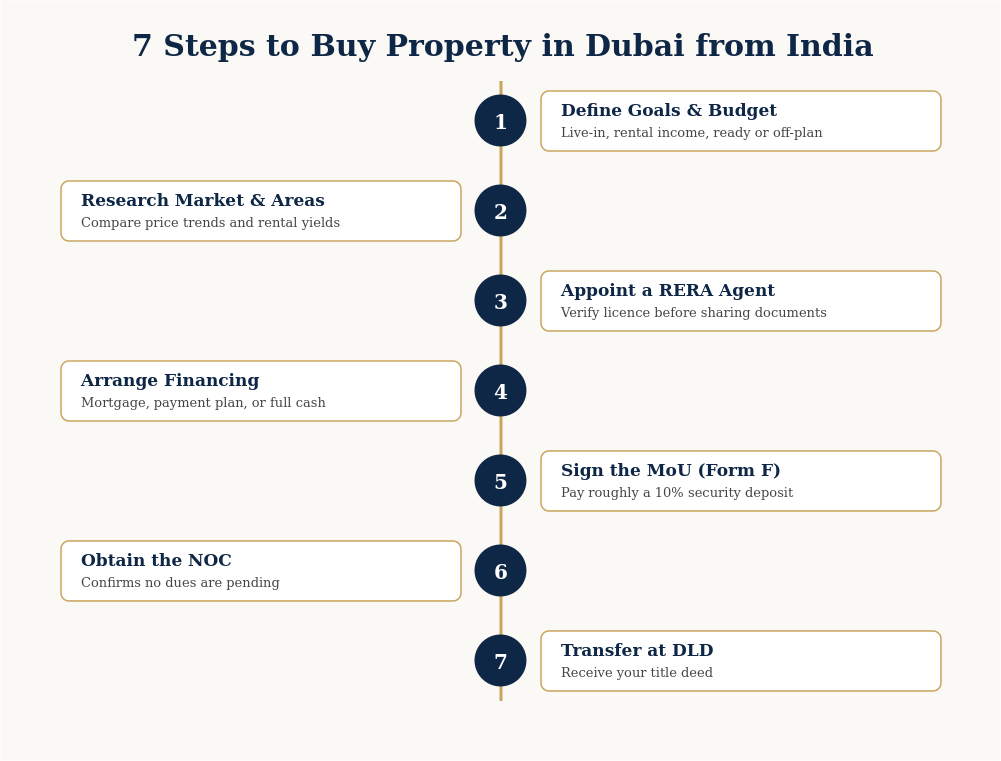
Step 1: Get Clear on Your Goal and Budget
Decide upfront whether you’re buying to live in, to rent out, or purely for capital appreciation, and whether you want a ready unit or an off-plan project. This single decision shapes almost every choice that follows: area, payment structure, financing, and even the type of agent you need.
Step 2: Research the Market and Shortlist Areas
Dubai’s freehold zones each have a distinct character. Spend time comparing price trends, rental demand, and upcoming infrastructure before settling on a neighbourhood (see the area-by-area breakdown below).
Step 3: Work with a RERA-Registered Broker
A licensed agent gives you access to verified listings, helps you avoid overpriced inventory, and manages negotiations with the seller or developer. Always verify the agent’s RERA card and the brokerage’s DLD registration before sharing any documents or money.
Step 4: Arrange Financing, If Needed
If you’re not paying in full cash, decide between a developer payment plan (for off-plan property) or a mortgage from a UAE bank (for ready property). Indian non-residents can typically borrow up to 50-60% of the property value, depending on the bank and the buyer’s income profile.
Step 5: Sign the Memorandum of Understanding (MoU)
Once you’ve chosen a property, both parties sign an MoU, commonly known as Form F when registered through the DLD’s Trakheesi system. This sets out the agreed price, payment schedule, and timelines. A security deposit, usually around 10% of the purchase price, is paid at this stage and held until the deal completes.
Step 6: Obtain the No Objection Certificate (NOC)
The seller (or developer, for off-plan units) must provide an NOC confirming there are no outstanding service charges or dues on the property. This is mandatory before ownership can be transferred.
Step 7: Transfer Ownership at the Dubai Land Department
Buyer and seller (or their authorised representatives) meet at the DLD or a registered trustee office to complete the transfer. You’ll need the signed MoU, the NOC, identification documents for both parties, and a manager’s cheque for the balance amount. Once fees are paid and documents verified, the new title deed is issued in your name your final, legal proof of ownership
Documents Indian Buyers Typically Need
| Document | Why It’s Needed |
| Valid passport (and visa copy, if any) | Identity verification |
| PAN card | Recommended for financial record-keeping in India |
| Proof of income / salary certificate | Required for mortgage applications |
| Bank statements (last 3-6 months) | Demonstrates source of funds |
| Signed MoU / Form F | Legal agreement between buyer and seller |
| NOC from developer or seller | Confirms no pending dues on the property |
| Power of Attorney (if buying remotely via a representative) | Allows someone in Dubai to sign on your behalf |
| Title deed (for resale properties) | Confirms current ownership |
Why Dubai Appeals to Indian Buyers
A few reasons consistently come up when Indian investors explain why they chose Dubai over a second home in India:
- No income tax or capital gains tax on rental income or resale profit.
- Rental yields of roughly 5-8%, well above the 2-3% typically seen in cities like Mumbai or Bengaluru.
- Residency-linked investment: buying property above a certain value unlocks a long-stay UAE visa (more on this below).
- A mature, regulated market. Every transaction is registered with the Dubai Land Department (DLD), and brokers must be licensed with RERA (the Real Estate Regulatory Agency).
- Familiarity. With a large Indian expat community already living in Dubai, the city feels less “foreign” than other international markets.
That said, Dubai isn’t risk-free. Off-plan delays, service charges, and currency swings are real considerations. Treat this as you would any serious investment: with research, not just enthusiasm.
What Does It Actually Cost to Buy Property in Dubai?
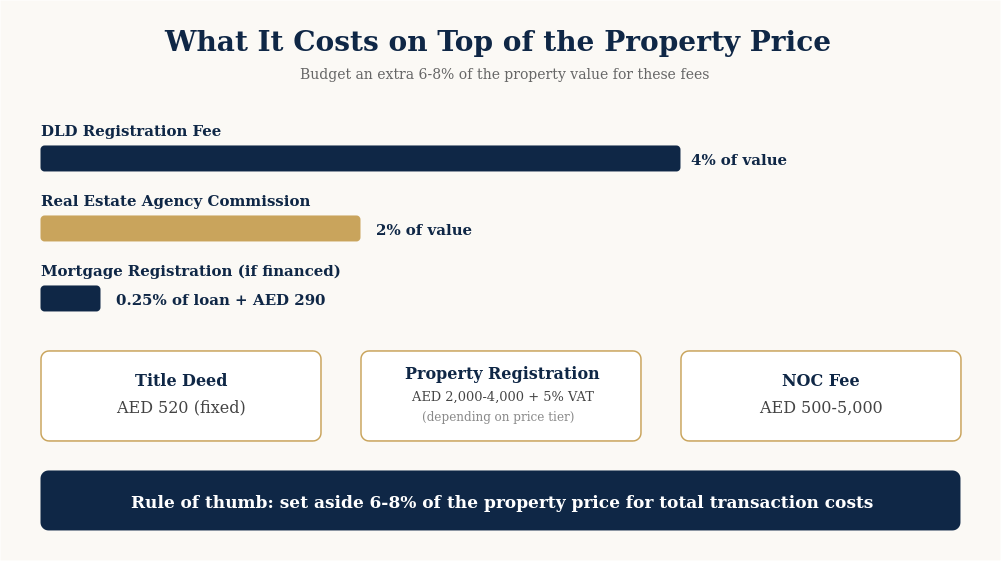
Beyond the purchase price, budget for these standard transaction costs:
| Fee | Approximate Cost |
| DLD Registration Fee | 4% of property value |
| Title Deed Issuance | AED 520 (fixed) |
| Property Registration Fee | AED 2,000 + 5% VAT (under AED 500,000) or AED 4,000 + 5% VAT (above AED 500,000) |
| Real Estate Agency Commission | 2% of property value |
| Mortgage Registration (if financing) | 0.25% of loan amount + AED 290 |
| NOC Fee (developer-dependent) | AED 500 – AED 5,000 |
As a rule of thumb, set aside an additional 6-8% of the property’s price to cover these costs comfortably.
Financing Options for Indian Buyers
- Non-resident mortgage: Several UAE banks offer mortgages to Indian buyers without local residency, usually financing 50-60% of the property’s value at interest rates in the 4-5% range. Comparing two or three lenders, or working with a mortgage broker, is worth the time.
- Developer payment plans: For off-plan property, developers often allow a 10-20% down payment followed by instalments tied to construction milestones, with a balloon payment on or after handover.
- Full cash purchase: Buying outright simplifies the process and can strengthen your negotiating position, but make sure all transfers go through proper banking channels under the LRS to stay compliant with Indian regulations.
Best Areas in Dubai for Indian Buyers
- Dubai Marina – Waterfront apartments, strong rental demand, vibrant lifestyle.
- Downtown Dubai – Premium addresses near Burj Khalifa and Dubai Mall; high capital appreciation, higher entry price.
- Business Bay – Centrally located, popular with professionals wanting a short commute.
- Jumeirah Village Circle (JVC) – More affordable entry point with steady rental yields, popular among first-time investors.
- Palm Jumeirah – Luxury villas and beachfront apartments for high-net-worth buyers.
- Arabian Ranches & Dubai Hills Estate – Family-friendly villa communities with schools and parks.
- Dubai Silicon Oasis & International City – Budget-friendly options popular with Indian tech professionals and first-time investors.
Residency Visas Linked to Property Investment
Property investment in Dubai can also open the door to long-term UAE residency:
- Property Investor Visa: Available for investments of AED 750,000 or above, typically renewable every 2 years.
- Golden Visa: Available for investments of AED 2 million or above, offering 10-year renewable residency without the need for a local sponsor or employer.
These visas don’t require you to give up Indian citizenship, but they do come with their own eligibility and renewal conditions, so it’s worth confirming current criteria with a licensed visa consultant before you commit funds.
Tax and Compliance Checklist for Indian Buyers
No property tax in Dubai, but Indian buyers must still declare the asset annually under the Foreign Assets Schedule in their ITR.
Rental income earned abroad is taxable in India under global income rules, even though Dubai itself doesn’t tax it. Claim relief under the India-UAE Double Taxation Avoidance Agreement (DTAA) where applicable, and consult a chartered accountant for the latest treatment.
Repatriating rental income or resale proceeds back to India must follow LRS documentation and RBI reporting norms.
Keep every remittance receipt, MoU, NOC, and title deed copy organised. These are exactly what your CA and the Income Tax Department will ask for if your foreign asset disclosure is ever reviewed.
Common Mistakes Indian Buyers Should Avoid
- Skipping due diligence on the developer or seller: check the project’s track record and the DLD’s official project status before paying anything.
- Underestimating ongoing service charges, which vary significantly between buildings and can meaningfully affect net rental yield.
- Buying through unregistered agents: always confirm RERA registration.
- Ignoring currency risk on a multi-instalment off-plan purchase, where INR-AED movement over 2-3 years can change your effective cost.
- Not budgeting for the full 6-8% in transaction fees, leading to last-minute cash crunches.
- Treating it as a guaranteed quick flip: Dubai rewards patient, research-backed investors more than speculative ones.
Frequently Asked Questions
Yes. Many Indian buyers complete the entire process remotely using a Power of Attorney and digital documentation, though visiting at least once before finalising is a sensible precaution.
Up to USD 250,000 per financial year per individual under the RBI’s Liberalised Remittance Scheme. Family members can combine their individual limits for a single purchase, provided the funds genuinely come from each person’s own account.
Dubai itself does not tax rental income, but as an Indian tax resident, you must declare global income, including foreign rental income, in your Indian tax return. DTAA provisions can help avoid double taxation.
AED 750,000 for the renewable Property Investor Visa, and AED 2 million for the 10-year Golden Visa.
It’s not always mandatory for a cash purchase, but it makes mortgage payments, service charge payments, and rental income collection significantly easier if you’re a regular landlord.
Yes, most major UAE banks offer mortgages to non-resident Indian buyers, generally financing 50-60% of the property’s value, subject to income verification and credit checks
Sources
- Reserve Bank of India – Liberalised Remittance Scheme (LRS) FAQs
- Reserve Bank of India – Master Direction on Liberalised Remittance Scheme
- Dubai Land Department (DLD) – Official Website
- Dubai Land Department – RERA (Real Estate Regulatory Agency)
- Dubai Land Department – Golden Visa Application (Real Estate Investor)
- The Official Portal of the UAE Government – Golden Visa
- General Directorate of Residency and Foreigners Affairs, Dubai (GDRFA) – Golden Residence Permit for Investors
- Ministry of Economy & Tourism, UAE – Golden Visa Real Estate Investor Conditions
- Income Tax Department, India – Foreign Asset (Schedule FA) Reporting Guidance
People are also reading: