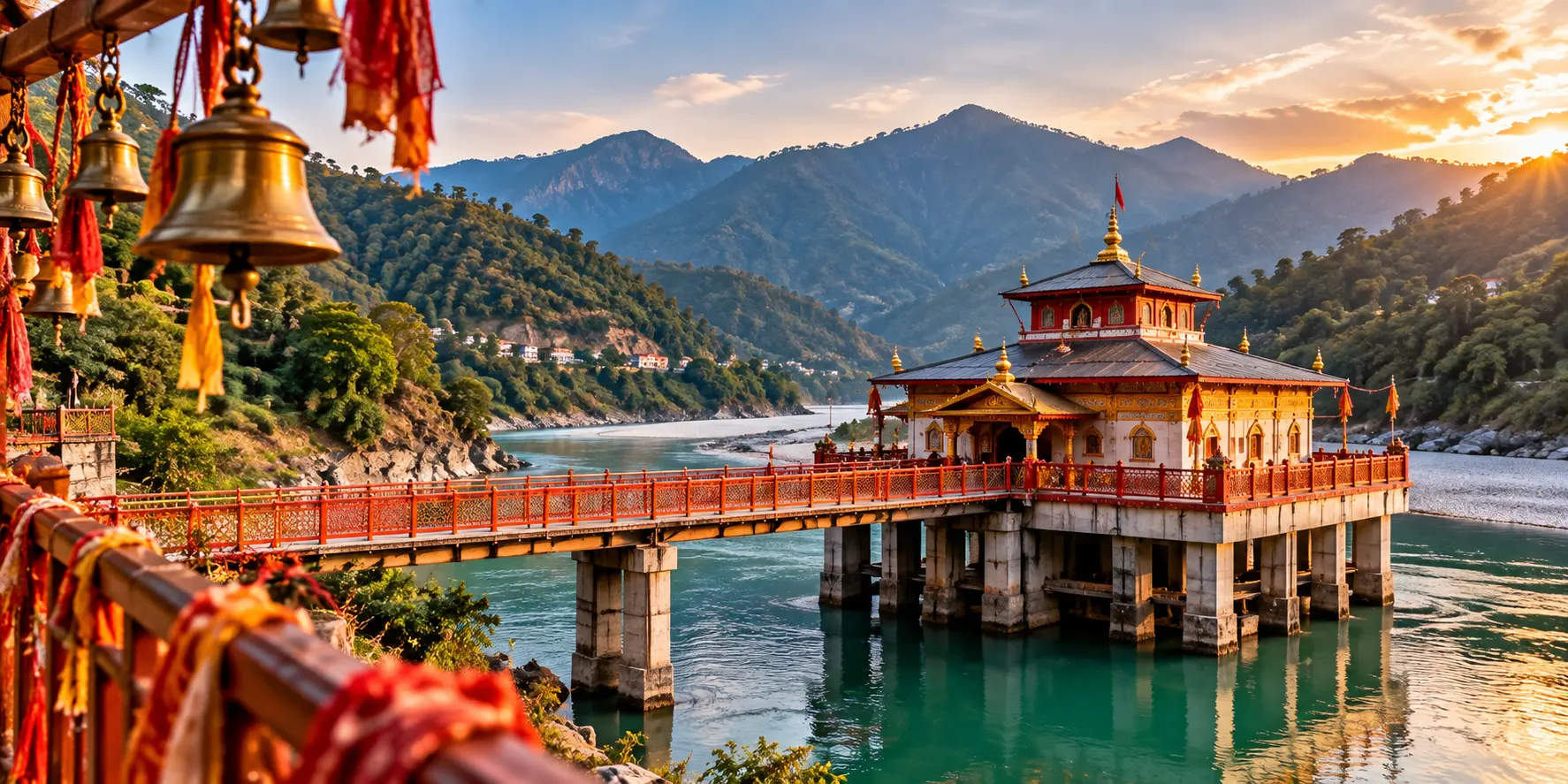
The Dhari Devi Temple is a sacred Hindu shrine on the banks of the Alaknanda River in Kalyasaur, near Srinagar in the Garhwal region of Uttarakhand. Dedicated to Maa Dhari Devi, who is worshipped as a form of Goddess Kali, the temple is considered the guardian deity of the region.
The temple is also known for its legends, the belief that Maa Dhari Devi changes her appearance during the day, and its controversial relocation in 2013. If you are travelling from Srinagar Garhwal towards Rudraprayag, Kedarnath, Badrinath, or other parts of Garhwal, you can easily include Dhari Devi Temple in your route.
Dhari Devi Temple Information
- Location: Kalyasaur, Pauri Garhwal, Uttarakhand
- River: Alaknanda River
- Nearest town: Srinagar, Garhwal
- Distance from Srinagar: About 15 km
- Distance from Rudraprayag: About 20 km
- Deity: Maa Dhari Devi
- Best known for: Legends, river setting, and 2013 relocation
- Nearest railway station: Rishikesh
- Nearest airport: Jolly Grant Airport, Dehradun
Where Is Dhari Devi Temple?
Dhari Devi Temple is located at Kalyasaur in Pauri Garhwal district, on the banks of the Alaknanda River between Srinagar Garhwal and Rudraprayag.
The temple is around 15 km from Srinagar and about 20 km from Rudraprayag. Because it lies along the main route, many pilgrims and travellers stop here while travelling towards Kedarnath, Badrinath, Chopta, and other destinations in the Garhwal Himalayas.
The first thing you notice when you reach the temple is its setting. The shrine stands above the river, with steep green mountains around it. The sound of the Alaknanda below makes the place feel very different from a typical roadside temple.
The Mystery of Dhari Devi Temple
If you search for Dhari Devi Temple online, you will quickly come across the word “mystery.” Most of this comes from the temple’s unusual traditions and the stories surrounding the goddess.
The Idol That Changes Appearance
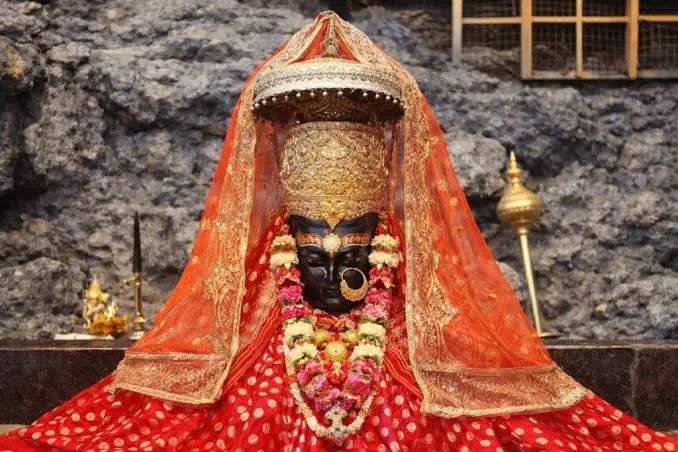
One of the most famous beliefs is that the face of Maa Dhari Devi changes during the day.
Devotees traditionally believe that she appears:
- Like a young girl in the morning
- Like a woman during the afternoon
- Like an elderly woman in the evening
This belief is an important part of the temple’s religious tradition. It is better understood as a matter of faith and local belief rather than something that has been scientifically established.
Why Is the Temple Open to the Sky?
Another interesting tradition is that the deity is kept under the open sky. According to local belief, Maa Dhari Devi should not be enclosed beneath a conventional roof.
This also gives the temple a distinctive appearance. You can see the mountains and sky around the shrine while the Alaknanda flows below.
History of Dhari Devi Temple
There is no single documented account of the temple’s exact age. Much of its early history comes from local traditions passed down through generations.
According to one popular tradition, a flood carried away the idol of Dhari Devi, which later became trapped near Dharo village. Villagers are said to have heard cries from the river and received a divine message to establish the idol at that spot.
The shrine is associated with Goddess Kali and is traditionally regarded as a guardian deity of the Garhwal region. It is also connected with the wider Shakti tradition, although its classification as a Shakti Peetha or Shakti Sthal varies across religious sources.
The Story and Legend of Maa Dhari Devi
One popular legend tells of Dhari Devi as the only sister among seven brothers. After their parents died, her brothers allegedly killed her and threw her into the Alaknanda River.
According to the story, her head became trapped against a rock near the present temple, while the lower part of her body is associated with Kalimath. A divine voice is also said to have guided a local villager to recover the idol and establish it for worship.
This legend remains an important part of the faith and local traditions surrounding Maa Dhari Devi.
Why Is Dhari Devi Temple Considered Important?
Dhari Devi is traditionally regarded as a guardian deity of Uttarakhand. She is also believed by devotees to protect pilgrims travelling towards the Char Dham shrines.
The goddess has another unusual connection with Kalimath Temple. According to local religious tradition, the upper part of the deity is worshipped at Dhari Devi, while the lower part is associated with Kalimath, where the goddess is worshipped in her Kali form.
For many pilgrims, visiting Dhari Devi is therefore not simply about stopping at a temple. It is part of the spiritual journey through the Garhwal Himalayas.
What Happened to Dhari Devi Temple in 2013?
The 2013 story is probably the most talked-about part of the temple’s recent history.
The original shrine stood much closer to the river. When the Alaknanda Hydro Power Project was being developed, the temple had to be relocated to a raised platform to protect it from being submerged.
The idol was moved on 16 June 2013.
Soon afterwards, Uttarakhand experienced one of the most devastating natural disasters in its recent history. Extremely heavy rainfall, cloudbursts, floods and landslides affected large parts of the state.
The timing of the temple’s relocation and the disaster led to strong beliefs among many devotees and local residents that moving Maa Dhari Devi from her original place had angered the goddess.
You will still hear this story when talking to people about the temple.
However, it is important to separate belief from established fact. There is no scientific evidence that relocating the temple caused the 2013 floods. The disaster was associated with extreme rainfall, cloudbursts, flooding and landslides across the region.
For visitors, the 2013 incident remains an important part of the temple’s modern story because it has shaped how many people understand and remember Dhari Devi.
The Present Dhari Devi Temple
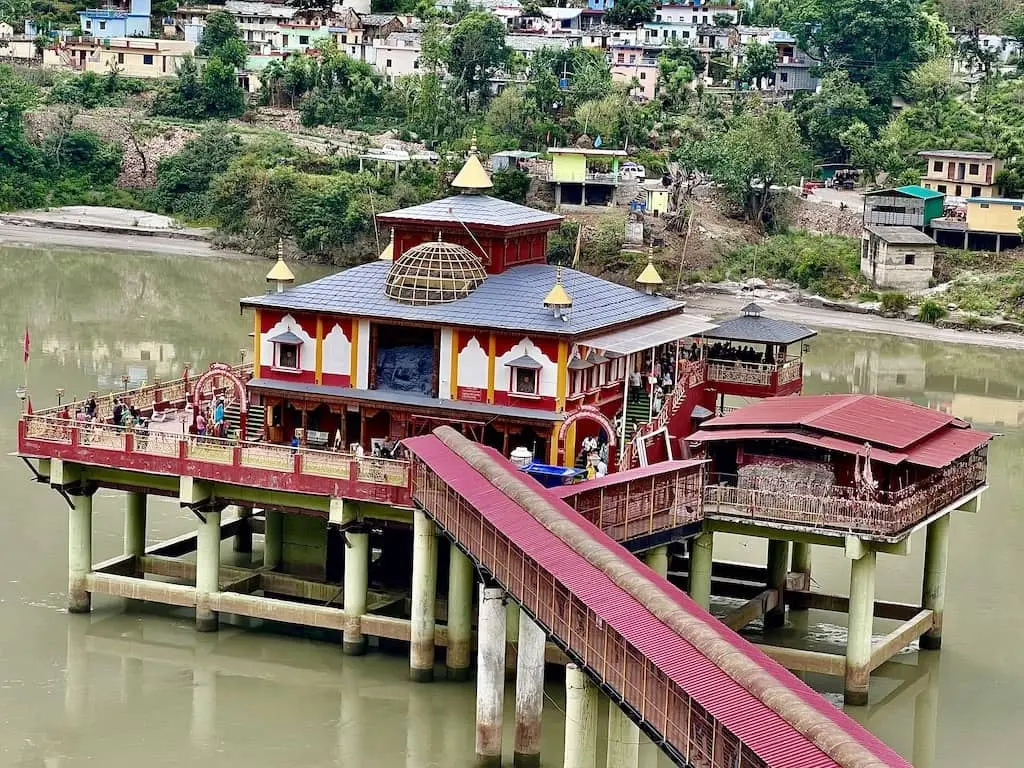
The temple you see today stands on a raised platform above the Alaknanda.
From the main road, visitors follow a pathway towards the river and cross a pedestrian bridge to reach the shrine. The Pauri Garhwal district administration describes the approach as a roughly 1 km cement pathway.
The walk itself is not difficult for most visitors, but older travellers may want to take their time.
Once you reach the temple, there is not a huge complex to explore. The attraction is really the shrine itself, the river below and the surrounding Himalayan landscape.
Dhari Devi Temple Timings
Dhari Devi Temple is generally visited from the morning onwards, with a break during the afternoon. Commonly reported timings are around 6:00 AM to 7:00 PM, although timings can change on festival days and during special religious occasions.
If you are travelling specifically for darshan, it is better to confirm the day’s timings locally rather than depending entirely on online listings.
During Navratri, the temple can be much busier than usual, so allow extra time.
Is There Any Entry Fee?
There is generally no entry fee for visiting Dhari Devi Temple.
If you want to offer prayers, flowers or other offerings, you can do so according to your preference. For any special puja, it is better to ask at the temple rather than relying on unofficial information.
How to Reach Dhari Devi Temple
The easiest way to reach Dhari Devi is by road. Since the temple is located between Srinagar and Rudraprayag, it fits naturally into a Garhwal road trip.
By Road
From Srinagar Garhwal, the temple is around 15 km away towards Rudraprayag. From Rudraprayag, it is roughly 20 km towards Srinagar.
You can use a private car, taxi, shared jeep or bus depending on your route. If you are travelling by public transport, Srinagar and Rudraprayag are the most useful nearby towns for finding onward transport.
From Rishikesh
Rishikesh is approximately 115–120 km from Dhari Devi by road. The route takes you through the Himalayan roads towards Devprayag and Srinagar before reaching the temple. A private taxi is convenient if you want to stop at places along the way, while buses are a more economical option.
From Haridwar
Haridwar is roughly 140 km away by road. You first travel towards Rishikesh and then continue through Devprayag and Srinagar.
If you are starting from Delhi, Haridwar or Rishikesh can be useful points from where you continue into Garhwal.
By Train
The nearest major railway station used by travellers is Rishikesh Railway Station.
From there, you can take a bus, shared taxi or private cab towards Srinagar and then continue to Dhari Devi.
Haridwar is another practical railway option, especially if you find a more convenient train connection there.
By Air
The nearest airport is Jolly Grant Airport near Dehradun.
From the airport, the road journey goes through Rishikesh, Devprayag and Srinagar before reaching Dhari Devi. A private taxi is the easiest option if you are travelling directly from the airport.
Dhari Devi Temple Distance from Major Places
| From | Approx. Distance |
| Srinagar Garhwal | 13 to 15 km |
| Rudraprayag | 19 km |
| Devprayag | 47 to 48 km |
| Rishikesh | 118 to 120 km |
| Haridwar | Around 139 to 142 |
| Jolly Grant Airport | Around 130– 133 km |
| Delhi | Around 340–360 km |
These are approximate road distances. Actual travel time can change because mountain roads are affected by traffic, weather, roadwork and seasonal conditions.
Best Time to Visit Dhari Devi Temple
Dhari Devi Temple can be visited throughout the year, but the experience changes with the weather and season.
- March to June: Pleasant weather makes this a good time for temple visits and road trips. Days are comfortable, especially for combining Dhari Devi with nearby places.
- July to September: Monsoon brings heavy rain to the region. Landslides, falling rocks and road delays are possible, so check the weather and road conditions before travelling.
- October to November: Cool weather and clearer mountain views make these months comfortable for travelling through the Alaknanda valley.
- December to February: Winter is colder, particularly in the surrounding hills. You can still visit, but carry warm clothes and check road conditions before starting your journey.
For festivals: Navratri is an important time at the temple, but expect larger crowds during the celebrations.
How Much Time Do You Need at Dhari Devi?
You don’t need an entire day for Dhari Devi.
For a normal visit, keeping 1 to 2 hours is enough for the walk to the temple, darshan, spending some time around the shrine and returning to your vehicle.
If you are visiting during Navratri or another busy period, keep some extra time because the queue and parking situation can change.
Places to Visit Near Dhari Devi Temple
One good thing about visiting Dhari Devi is that you don’t have to make a separate trip just for the temple. It falls on the Srinagar–Rudraprayag route, so you can easily add a few nearby places depending on where you are coming from and where you are heading next.
Srinagar Garhwal
Srinagar is only around 13–15 km from Dhari Devi and is a convenient place to stop for food, hotels, fuel or transport. If you are not in a hurry, you can also spend the night here before continuing towards Rudraprayag.
Rudraprayag
About 19–20 km from the temple, Rudraprayag is where the Alaknanda and Mandakini rivers meet. It is also a useful stop if your journey continues towards Kedarnath, Chopta or other parts of Garhwal.
Devprayag
If you are travelling from Rishikesh, Devprayag comes along the way and makes a worthwhile stop. The town is known for the meeting of the Alaknanda and Bhagirathi rivers and has a peaceful riverside setting.
Khirsu
Khirsu is a quieter option if you want to spend some time in the hills rather than visit another busy town. It is surrounded by forests and villages and is a nice place to slow down and enjoy the mountain views.
Kalimath
Kalimath is another important religious place in the region and is associated with the worship of Goddess Kali. It is especially worth visiting if you are interested in the legends and religious traditions connected with Dhari Devi.
Where to Stay Near Dhari Devi Temple
There are limited places to stay close to Dhari Devi Temple, so most travellers stay in Srinagar, Rudraprayag or Khirsu.
- Stay in Srinagar: Best if you want easy access to hotels, restaurants, fuel and local transport. It is also the most convenient base for visiting Dhari Devi and continuing towards Badrinath or Rudraprayag.
- Stay in Rudraprayag: A practical choice if Dhari Devi is one stop on a longer trip towards Kedarnath, Chopta or Ukhimath. You will also have more options for food and accommodation.
- Stay in Khirsu: Choose Khirsu if you prefer a quieter mountain stay with forests, village surroundings and Himalayan views.
If Dhari Devi is only a short stop on your road trip, there is no need to stay nearby. You can visit the temple and continue towards your next destination.
Things to Keep in Mind Before Visiting
Dhari Devi is an active place of worship, so treat it as a temple first and a sightseeing stop second.
A few simple things will make your visit easier:
- Wear comfortable footwear for the walk to the shrine.
- Dress modestly.
- Carry water, especially during summer.
- Keep a rain jacket or umbrella during monsoon.
- Follow photography restrictions around the shrine.
- Avoid littering near the river and temple.
- During festivals, expect larger crowds.
- Check road conditions before travelling in monsoon or winter.
Is Dhari Devi Temple Worth Visiting?
If you are already travelling through the Srinagar–Rudraprayag route, Dhari Devi is an easy place to include in your itinerary.
The temple doesn’t require a full-day visit, but it offers something that many tourist attractions cannot: a chance to see a living Himalayan tradition in its natural setting. The Alaknanda flowing below, the mountain landscape around the shrine and the stories associated with Maa Dhari Devi make the visit memorable.
For pilgrims, it holds deep religious importance. For travellers, it offers a closer look at the faith, folklore and landscape that make Garhwal so special.
Final Thoughts
Dhari Devi Temple is a small stop on the map, but there is a lot of history, faith and local tradition connected to it. The temple’s setting above the Alaknanda River also makes the visit feel very different from a typical temple stop.
If you are travelling between Srinagar and Rudraprayag, it is worth keeping an hour or two for Dhari Devi. Visit the shrine, take a moment by the river, and enjoy the mountain surroundings before continuing your journey.
Frequently Asked Questions
Yes, families can visit Dhari Devi Temple, but elderly visitors should take care on the approach to the shrine, especially during busy periods or wet weather.
There are small local shops around the temple area, but options can be limited. It is better to carry water and some snacks, especially if you are travelling with children.
Photography is strictly prohibited inside the main sanctum and of the main idol. You can generally take photographs outside the main worship area, including the bridge and surrounding landscape. Avoid photography during aarti and other rituals unless permitted.
Comfortable and modest clothing is suitable for the temple. Since the weather can change quickly in the hills, carry a light jacket or extra layer depending on the season.
Yes. Its location along the Srinagar-Rudraprayag route makes it convenient to include as a short stop during a family road trip through Garhwal.
People are also reading: