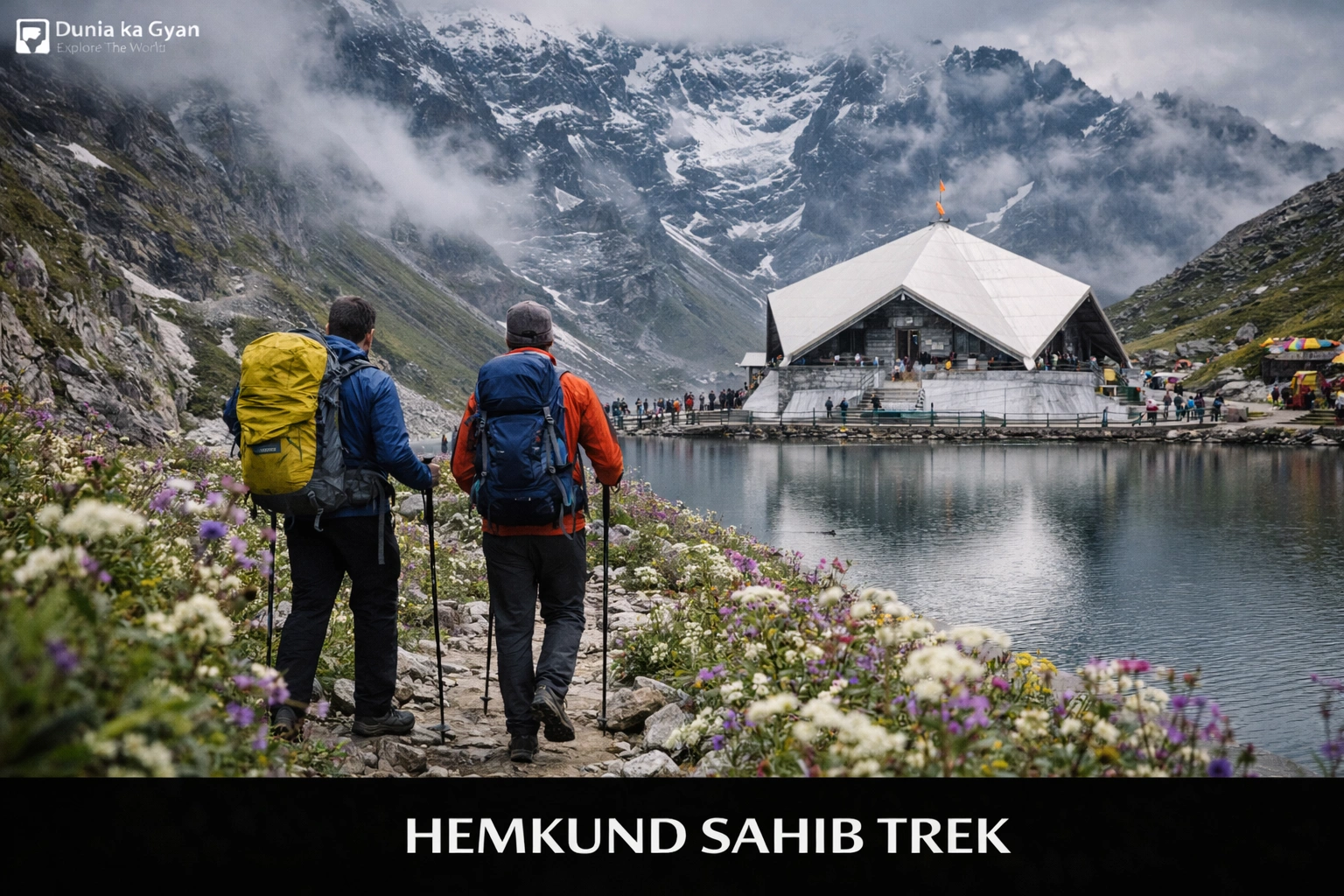
High in the Garhwal Himalayas of Uttarakhand lies one of the most sacred pilgrimage destinations in India. This Hemkund Sahib Trek Guide explains everything you need to know about visiting Hemkund Sahib, including the trekking route, history, altitude, travel tips, and the best time to visit. Surrounded by snow-covered peaks and a crystal-clear glacial lake, Hemkund Sahib sits at an altitude of about 4,329 meters (14,200 feet) above sea level.
Every year thousands of pilgrims and trekkers travel to Hemkund Sahib not only for spiritual devotion but also to experience one of the most beautiful high-altitude landscapes in the Himalayas. The journey itself is unforgettable: steep mountain paths, flowing rivers, alpine forests, and, finally, the peaceful sight of the Gurudwara standing beside the sacred Hemkund Lake.
For many travelers, reaching Hemkund Sahib is more than just a trek, it is a spiritual and emotional experience. The calm atmosphere of the lake and the sound of prayers inside the Gurudwara create a sense of peace that is hard to describe.
History and Spiritual Significance of Hemkund Sahib
Hemkund Sahib holds great importance in Sikh history and spirituality. According to Sikh belief, Guru Gobind Singh, the tenth Sikh Guru, meditated at this sacred location in his previous life. The story is mentioned in the Sikh religious text Bachittar Natak, where the Guru describes a place surrounded by seven snowy peaks where he performed meditation.
The word “Hemkund” literally means “Lake of Snow.” The location remained relatively unknown for many years until it was rediscovered in the early 20th century. Later, Sikh devotees built the present-day Hemkund Sahib Gurudwara beside the lake to mark the sacred site.
Today the Gurdwara is considered one of the highest Sikh shrines in the world, attracting pilgrims from across India and other countries.
Hemkund Sahib Location
Hemkund Sahib is located in the Chamoli district of Uttarakhand, deep in the Garhwal Himalayan region. The trek begins from the small town of Govindghat, which lies on the road connecting Joshimath and Badrinath Temple.
From Govindghat, travelers trek through the village of Ghangaria, which serves as the base camp for both Hemkund Sahib and the famous Valley of Flowers National Park.
How to Reach Hemkund Sahib
Reaching Hemkund Sahib requires a combination of road travel and trekking. Most pilgrims begin their journey from Haridwar or Rishikesh, which are well-connected to major Indian cities.
By Air
The nearest airport is Jolly Grant Airport, located around 275 km from Govindghat. From the airport, travelers can hire taxis or take buses to reach Joshimath or Govindghat.
By Train
The nearest railway station is Rishikesh Railway Station. From here buses and taxis regularly travel toward Govindghat.
By Road
Govindghat is well connected by road to major towns in Uttarakhand.
Distance overview:
Haridwar → Govindghat: approx. 300 km
Rishikesh → Govindghat: approx. 275 km
Joshimath → Govindghat: approx. 20 km
From Govindghat, travelers must complete a 19 km trek via Ghangaria to reach Hemkund Sahib.
Highlights of Hemkund Sahib
Altitude: 4,329 meters (14,200 ft)
Activities to Do
- Trekking in the Himalayas
- Visiting Hemkund Sahib Gurudwara
- Meditation and prayer near Hemkund Lake
- Photography of alpine landscapes
- Visiting Valley of Flowers nearby
Nearest Bus Stand
- Govindghat Bus Stand
Nearest Railway Station
- Rishikesh Railway Station
Nearest Airport
- Jolly Grant Airport
Hemkund Sahib Trek Guide: Route and Distance
Reaching Hemkund Sahib requires completing one of the most scenic treks in Uttarakhand. The total trekking distance is around 19 kilometers, divided into two main sections.
Govindghat to Ghangaria Trek (13 km)
The journey begins at Govindghat, where the trekking route follows the river Lakshman Ganga. The trail is relatively gradual and passes through forests, bridges, and waterfalls. Many pilgrims complete this section in 5–7 hours.
Along the route you will find small tea stalls, resting points, and pony services for travelers who prefer not to walk the entire distance.
Ghangaria to Hemkund Sahib Trek (6 km)
However, the second part of the trek from Ghangaria to Hemkund Sahib is more challenging. The trail becomes steep and climbs rapidly through rocky terrain. Although the distance is only about 6 km, it can take 3–5 hours due to the high altitude and steep incline.
However, the moment you reach the top and see the serene Hemkund Lake beside the Gurudwara, the effort feels completely worthwhile.
Hemkund Sahib Trek Guide: Difficulty Level
Overall, the Hemkund Sahib trek is considered moderately difficult due to steep climbs and high altitude. While thousands of pilgrims complete the trek every year, it can be physically demanding for beginners.
The most challenging part of the trek is the 6 km climb from Ghangaria to Hemkund Sahib, where the trail becomes steep and the altitude increases rapidly.
Some common challenges include:
- Steep mountain paths
- High altitude (over 4,000 meters)
- Low oxygen levels
- Cold weather conditions
However, with proper preparation and a slow pace, most travelers can complete the trek comfortably. Many pilgrims also use ponies or palanquins to reach the shrine.
Hemkund Lake and the Seven Peaks
One of the most striking features of Hemkund Sahib is the glacial lake located next to the Gurudwara. Known as Hemkund Lake, the water is extremely cold and remains partially frozen even during summer months.
The lake is surrounded by seven snow-covered mountain peaks, which adds to the mystical beauty of the place. Pilgrims often take a quick dip in the icy water as a spiritual ritual before entering the gurdwara.
Even in summer, the temperature near the lake can be quite cold due to the high altitude.
Things to Do in Hemkund Sahib
Visiting Hemkund Sahib is not only a spiritual journey but also an opportunity to experience the breathtaking beauty of the Garhwal Himalayas.
In addition, travelers can enjoy several meaningful experiences during their visit. From scenic trekking trails to alpine lakes and rare Himalayan flowers, the journey offers a unique blend of spirituality, adventure, and nature.
Visit Hemkund Sahib Gurudwara
The most important activity at Hemkund Sahib is visiting the sacred Hemkund Sahib Gurudwara, which stands beside the glacial Hemkund Lake at an altitude of 4,329 meters.
The Gurdwara is known for its unique star-shaped architecture designed to withstand heavy snowfall in winter. Pilgrims gather here to offer prayers and listen to Gurbani. The peaceful environment, combined with the sound of prayers echoing across the mountains, creates a deeply spiritual experience.
For many visitors, sitting quietly inside the Gurudwara after completing the difficult trek becomes one of the most memorable moments of the journey.
Take a Dip in the Sacred Hemkund Lake
The beautiful Hemkund Lake is next to the Gurudwara and is surrounded by snow-covered mountains.
Many pilgrims take a quick dip in the icy water before entering the Gurudwara as part of a religious ritual. The water is extremely cold because it is fed by glacial melt, but it is believed to purify the soul.
Even if you do not take a dip, sitting beside the lake and enjoying the serene Himalayan views is an unforgettable experience.
Experience the Hemkund Sahib Trek
One of the highlights of visiting Hemkund Sahib is the Govindghat to Hemkund Sahib trek. The trek begins at Govindghat and passes through forests, waterfalls, and scenic mountain trails before reaching Ghangaria.
The final stretch from Ghangaria to Hemkund Sahib is a steep climb but offers spectacular views of the surrounding mountains. Along the route, trekkers can see waterfalls, glaciers, and alpine landscapes that make the journey truly rewarding.
Explore the Surrounding Himalayan Landscapes
The entire region around Hemkund Sahib is surrounded by the stunning Garhwal Himalayan range. Snow-covered mountains, lush green valleys, and fresh mountain air make the area ideal for nature lovers and photographers.
During the summer months, the hillsides are filled with colorful alpine flowers and green meadows, creating a breathtaking natural landscape.
Witness Rare Himalayan Flowers
The high-altitude region around Hemkund Sahib is home to several rare Himalayan plants. One of the most famous flowers found here is the Brahma Kamal, which is also the state flower of Uttarakhand.
This flower grows in high-altitude Himalayan regions and holds religious significance in Hindu traditions. Seeing it blooming in the wild during the trek is a special experience for many travelers.
Visit the Valley of Flowers
Many travelers combine the Hemkund Sahib pilgrimage with a visit to the nearby Valley of Flowers National Park.
The valley is famous for its vibrant alpine flowers and rich biodiversity. During July and August, thousands of colorful flowers bloom across the valley, transforming it into one of the most beautiful natural landscapes in India.
For nature enthusiasts, this is one of the biggest highlights of the trip.
Experience Langar at the Gurudwara
Like all Sikh Gurudwaras, Hemkund Sahib offers langar, a community kitchen where free vegetarian meals are served to pilgrims.
After completing the difficult trek, the warm tea and simple food provided at the Gurudwara feel incredibly comforting. The langar reflects the Sikh values of equality, hospitality, and service.
Best Time for the Hemkund Sahib Trek Guide
Hemkund Sahib remains open only for a limited period each year because the region is covered with snow during winter.
Opening Season
The Gurdwara usually opens in June and closes in October.
Best Months
June – Early July
- Pleasant weather
- Snow melting from surrounding peaks
- Ideal for pilgrimage
Mid July – August
- Valley of Flowers is in full bloom
- Lush greenery along trekking routes
September
- Clear skies and beautiful mountain views
- Fewer tourists compared to peak months
Winter travel is not possible because the entire region receives heavy snowfall.
Hemkund Sahib Weather and Temperature
Because Hemkund Sahib is located at a very high altitude, the weather remains cold even during summer months.
Summer (June – July)
Temperature: 5°C to 15°C
This is the most comfortable season for the Hemkund Sahib trek. Snow starts melting and trekking routes become accessible.
Monsoon (July – August)
Temperature: 5°C to 12°C
The surrounding valleys become lush and green, and the nearby Valley of Flowers National Park blooms with colorful flowers.
Autumn (September)
Temperature: 3°C to 10°C
Clear skies and spectacular Himalayan views make September a great time to visit.
Winter (October – May)
Temperature: Below 0°C
Heavy snowfall covers the region and the shrine remains closed.
Flora and Fauna Around Hemkund Sahib
The Hemkund Sahib region is part of the Himalayan alpine ecosystem and is home to several rare plants and flowers.
One of the most famous flowers found here is the Brahma Kamal, which blooms in the high altitudes of Uttarakhand. This flower holds religious importance in Hindu traditions and is also the state flower of Uttarakhand.
Other alpine plants and wildflowers grow in the surrounding meadows, making the trek especially beautiful during the monsoon months.
Wildlife in the region includes Himalayan birds, small mammals, and occasionally mountain goats.
Valley of Flowers and Hemkund Sahib
Many travelers combine the Hemkund Sahib trek with a visit to Valley of Flowers National Park.
Located just a few kilometers from Ghangaria, this valley is famous for its colorful alpine flowers and breathtaking scenery. During July and August, the valley becomes covered with thousands of blooming flowers of different species.
Because both destinations share the same base camp at Ghangaria, it is easy to visit them during the same trip.
Accommodation and Food
Most travelers stay overnight at Ghangaria, which has a range of accommodation options including guesthouses, lodges, and camps.
At Hemkund Sahib itself, the Gurudwara provides langar (community meals) for pilgrims. The langar is simple but nourishing, usually including hot tea, khichdi, and other vegetarian food.
The service is provided free of cost and reflects the Sikh tradition of community service.
Travel Tips for Hemkund Sahib Trek
Because Hemkund Sahib is located at a very high altitude, travelers should be prepared for changing weather and physical challenges.
Important Tips
- Start the trek early in the morning
- Carry warm clothes and rain protection
- Drink plenty of water during the trek
- Walk slowly to adjust to high altitude
- Spend a night at Ghangaria before climbing to Hemkund Sahib
- Carry basic medicines and energy snacks
Many travelers also choose to hire ponies or palanquins if they find the trek difficult.
Packing List for Hemkund Sahib Trek
Since the Hemkund Sahib trek takes place at high altitude, carrying the right gear is essential for a safe and comfortable journey.
Important items to pack include:
- Warm jacket and thermal clothing
- Waterproof trekking shoes
- Raincoat or poncho
- Woolen gloves and cap
- Water bottles and hydration packs
- Energy snacks and dry fruits
- Basic medicines and first-aid kit
- Sunscreen and sunglasses
- Trekking stick
Carrying proper gear can make the trek significantly easier, especially during unpredictable mountain weather.
Sample 3-Day Hemkund Sahib Travel Itinerary
Day 1
Travel from Rishikesh or Haridwar to Govindghat and trek to Ghangaria.
Day 2
Trek from Ghangaria to Hemkund Sahib and return to Ghangaria.
Day 3
Visit Valley of Flowers and return to Govindghat.
This itinerary allows travelers to explore both major attractions comfortably.
Nearby Places to Visit Near Hemkund Sahib
The region around Hemkund Sahib is filled with beautiful natural and spiritual destinations. Travelers often combine their visit with nearby attractions to experience the full beauty of the Garhwal Himalayas.
Valley of Flowers National Park
Distance from Hemkund Sahib: about 6 km trek (via Ghangaria)
One of the most famous natural attractions near Hemkund Sahib is Valley of Flowers National Park. This UNESCO World Heritage Site is known for its vast meadows filled with colorful alpine flowers.
During the monsoon months from July to September, the valley comes alive with hundreds of flower species, including orchids, poppies, daisies, and marigolds. The valley also supports rare wildlife species such as the Himalayan black bear, snow leopard, and blue sheep.
Nature lovers and photographers often consider the Valley of Flowers one of the most beautiful trekking destinations in India.
Highlights
- Best season: July to September
- Trek distance from Ghangaria: about 4 km
- Famous for: alpine flowers and Himalayan landscapes
Govindghat
Distance from Hemkund Sahib: about 19 km (trek route)
Govindghat is the starting point for the Hemkund Sahib trek. Located on the road connecting Joshimath and Badrinath, this small town serves as the base for pilgrims and trekkers.
Govindghat has parking areas, hotels, restaurants, and gurudwaras where travelers prepare for their trek. Many visitors spend a night here before beginning their journey toward Ghangaria.
Highlights
- Trek starting point for Hemkund Sahib
- Accommodation and parking facilities
- Gateway to Valley of Flowers trek
Ghangaria
Distance from Hemkund Sahib: 6 km
Ghangaria is a small but important settlement located in the Himalayas.
It serves as the base camp for both Hemkund Sahib and the Valley of Flowers. Almost every traveler stays here overnight before continuing their trek. The village offers guesthouses, camps, restaurants, and basic trekking facilities. Surrounded by mountains and forests, Ghangaria provides a peaceful resting point for trekkers.
Highlights
- Base camp for two famous treks
- Hotels and trekking accommodations
- Beautiful Himalayan surroundings
Badrinath Temple
Distance from Govindghat: about 25 km by road
The sacred Badrinath Temple is one of the most important Hindu pilgrimage sites in India and part of the Char Dham Yatra. Dedicated to Lord Vishnu, the temple is located along the banks of the Alaknanda River. The temple attracts thousands of pilgrims every year.
Many travelers visiting Hemkund Sahib also extend their trip to include Badrinath Temple.
Highlights
- One of the Char Dham pilgrimage sites
- Ancient temple dedicated to Lord Vishnu
- Beautiful Himalayan location
Joshimath
Distance from Govindghat: about 20 kM
Joshimath is an important hill town in the Chamoli district and serves as a gateway to several Himalayan destinations.
It is known for religious sites, scenic views, and its role as the winter seat of Lord Badrinath. Travelers often stop here before continuing their journey to Govindghat.
Highlights
- Gateway to Auli and Badrinath
- Ancient temples and monasteries
- Beautiful Himalayan views
Auli
Distance from Joshimath: about 10 km
The hill station Auli is one of the best skiing destinations in India.
Auli offers spectacular panoramic views of Himalayan peaks like Nanda Devi and is famous for winter sports activities. During summer, the green meadows and cool weather make it an ideal destination for trekking and sightseeing.
Highlights
- Famous ski resort in India
- Cable car ride from Joshimath
- Panoramic Himalayan mountain view
Hemkund Sahib Trek Distance
The total trekking distance to Hemkund Sahib is approximately 19 km from Govindghat.
Distance Breakdown
Govindghat → Ghangaria: 13 km
Ghangaria → Hemkund Sahib: 6 km
Most trekkers complete the journey in two days, staying overnight in Ghangaria before trekking to the shrine.
Why Hemkund Sahib Trek Is Unique
The Hemkund Sahib trek is not just another Himalayan trek. It is a journey that combines spiritual devotion, natural beauty, and physical endurance.
Unlike many trekking destinations, Hemkund Sahib attracts both adventure travelers and religious pilgrims. The sight of the Gurdwara standing beside the crystal-clear lake surrounded by snow-covered mountains creates a truly unforgettable experience.
For many visitors, the journey becomes a moment of reflection and inner peace, making it one of the most meaningful pilgrimages in India.
My Experience Visiting Hemkund Sahib
When I first reached the top after the steep climb from Ghangaria, I felt both exhausted and amazed. The moment the Gurudwara appeared beside the shining lake, surrounded by snow-covered mountains, it felt like stepping into another world.
Pilgrims quietly walked around the lake while others sat inside the Gurudwara listening to prayers. Despite the cold wind and thin air at such high altitude, there was a deep sense of peace. The warm tea served at the Gurudwara langar felt incredibly comforting after the long trek.
For many visitors, this combination of spiritual energy and natural beauty makes Hemkund Sahib a truly unforgettable destination.
Conclusion
The journey to the Hemkund Sahib trek guide is more than just a trek, it is a powerful blend of spirituality, adventure, and Himalayan beauty. Located in the Garhwal region of Uttarakhand, this sacred destination offers breathtaking views, peaceful surroundings, and a deeply spiritual atmosphere. The trek from Govindghat to Hemkund Sahib takes travelers through scenic mountain trails and alpine landscapes. Along the journey, visitors can also explore the nearby Valley of Flowers National Park. Whether for pilgrimage or trekking, Hemkund Sahib remains one of the most unforgettable high-altitude experiences in the Indian Himalayas.
Frequently Asked Questions
Hemkund Sahib is located in the Chamoli district of Uttarakhand in the Garhwal Himalayas at an altitude of about 4,329 meters.
The total trek distance is about 19 km from Govindghat via Ghangaria.
The trek is considered moderately difficult due to steep climbs and high altitude.
The best time to visit is between June and September when the shrine remains open.
Yes, beginners can complete the trek with proper preparation and a slow pace.
Yes, both destinations share the same base camp at Ghangaria and are often visited in the same trip.
Most travelers complete the journey in 2–3 days.
People are also reading: