
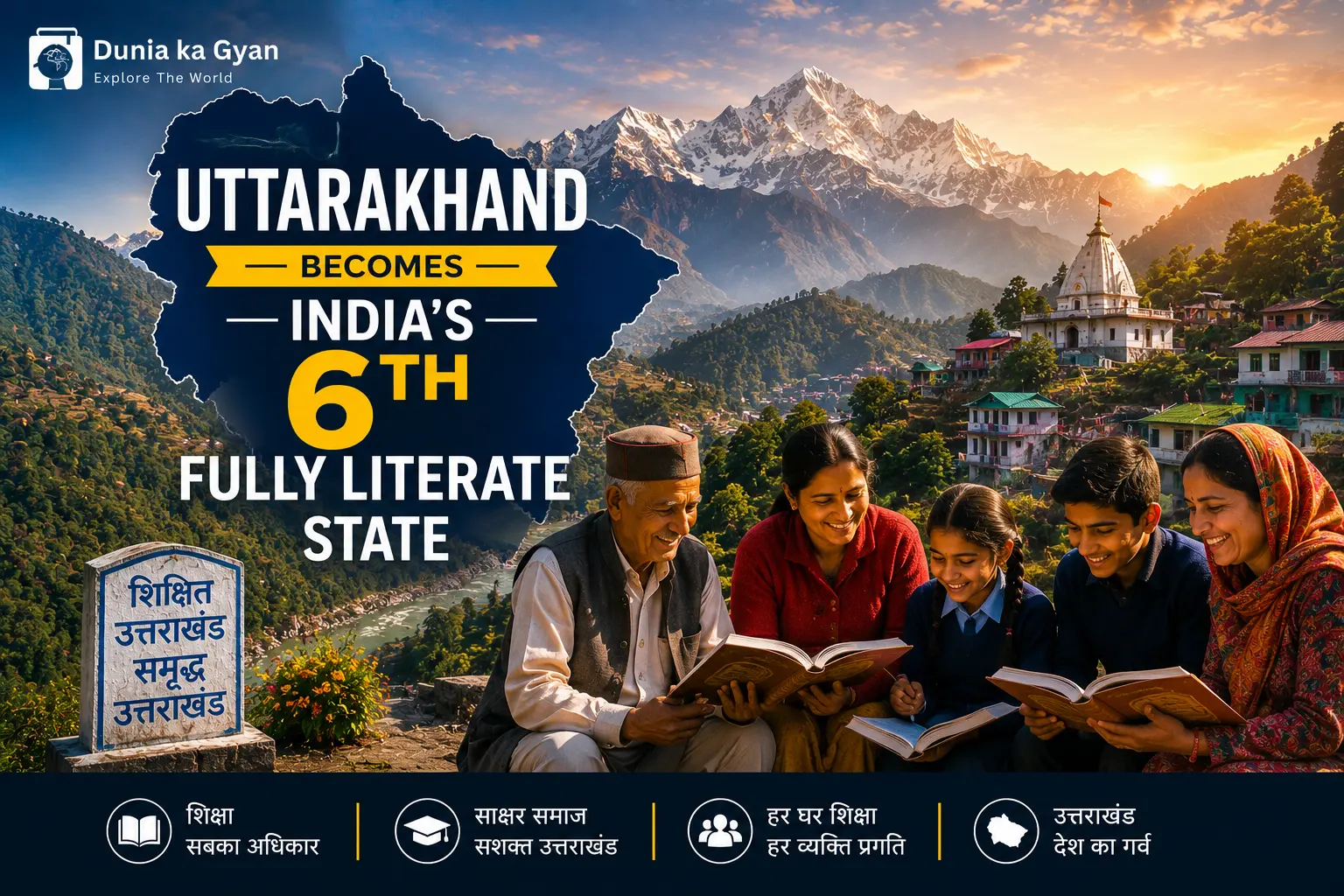
Uttarakhand has officially achieved a major milestone in India’s education sector by becoming the sixth fully literate state in the country. The state has recorded an adult literacy rate of more than 98%, which is significantly higher than the national benchmark of 95% set under the ULLAS programme. This achievement reflects decades of consistent efforts in improving education access, especially in rural and mountainous regions where delivering education has always been a challenge. The milestone highlights how structured government policies, community participation, and awareness campaigns can transform a state’s educational landscape over time.
Uttarakhand Becomes India’s 6th Fully Literate State: Key Highlights
- Adult literacy rate crosses 98%
- Approved by Uttarakhand state cabinet
- Proposal sent for central government certification
- Achieved under ULLAS programme
- Joins elite group of fully literate states in India
- Strong progress since 2001 census
Official Announcement and Recognition
The Uttarakhand cabinet, led by Chief Minister Pushkar Singh Dhami, officially approved the proposal declaring the state as fully literate after confirming that it has surpassed the required literacy benchmark. The proposal has now been forwarded to the Central Government for final validation under the national literacy framework. Once approved, Uttarakhand will be formally included in the list of literacy achievement in India under the ULLAS programme, marking a historic moment in the state’s educational journey.
What Is a Fully Literate State?
A fully literate state is defined under the ULLAS programme as a region where the adult literacy rate among individuals aged 15 years and above reaches at least 95%. This framework is not limited to basic reading and writing skills but also includes functional literacy, meaning individuals are able to apply these skills in daily life situations such as understanding government documents, managing financial tasks, and using basic digital tools. The programme also focuses on lifelong learning opportunities so that education continues beyond formal schooling and reaches all sections of society.
Uttarakhand’s Journey to Full Literacy
Uttarakhand’s journey toward full literacy has been gradual and deeply structured since its formation in 2000. In the early years, the state focused on expanding school infrastructure and increasing enrollment in rural and remote areas. According to census data, the literacy rate was 71.6% in 2001 and increased to 78.8% in 2011. After 2015, the state intensified adult education programs and community-based learning initiatives, which played a major role in accelerating literacy growth. By 2026, the literacy rate has crossed 98%, reflecting one of the most significant educational transformations among Indian states.
Source: Here
Literacy Rate in Uttarakhand Over the Years
The literacy rate in Uttarakhand has shown consistent and strong improvement over the past two decades. The growth has been driven by better access to schools, increased awareness about education, and targeted government schemes that focused on reducing dropout rates. Female literacy has also improved significantly, contributing to balanced social development across the state. The expansion of education in remote hilly regions has been particularly important in achieving near-universal literacy.
Government Initiatives Behind the Achievement
Several government initiatives played a key role in achieving full literacy in Uttarakhand, focusing on adult education, school enrollment, and digital learning. These efforts were implemented through structured programs under the ULLAS framework to improve literacy across all regions of the state.
1. Adult Education Programs
Under the ULLAS programme, Uttarakhand implemented large-scale adult education campaigns aimed at educating individuals who were previously left out of the formal education system. These programs focused on teaching basic reading, writing, and numeracy skills through community-based learning centers. Special attention was given to women, elderly citizens, and marginalized communities living in remote areas.
2. Digital Literacy Campaigns
Digital literacy initiatives were introduced to ensure that citizens could access modern technology and government services effectively. These programs included smartphone usage training, awareness about online services, and basic computer education. This helped reduce the digital divide between urban and rural populations and improved overall access to information.
3. School Enrollment Drives
School enrollment drives played a crucial role in increasing literacy rates among younger populations. These campaigns ensured that children from remote and economically weaker backgrounds were enrolled in schools and retained in the education system. Improved infrastructure, mid-day meal schemes, and awareness programs also supported higher attendance rates.
Factors That Contributed to Higher Literacy
Several combined factors played a major role in achieving this milestone. Strong government policies ensured continuous investment in education, while NGOs and volunteers supported grassroots implementation. Community participation in literacy drives helped extend education to remote villages, and corporate social responsibility initiatives provided additional support in infrastructure and learning resources. Together, these efforts created a strong ecosystem that supported widespread literacy growth.
Why This Achievement Matters for Uttarakhand
This achievement is highly significant for Uttarakhand because it directly impacts the overall quality of life of its citizens. Higher literacy levels lead to better employment opportunities, improved health awareness, and stronger participation in democratic processes. It also helps reduce poverty by enabling individuals to access better economic opportunities and government welfare schemes. In the long term, full literacy strengthens social equality and contributes to more stable and informed communities across the state.
How Uttarakhand Compares With Other Indian States
Uttarakhand now stands among a small group of Indian states that have achieved near-universal literacy under the ULLAS framework. While many states are still working toward achieving similar benchmarks, Uttarakhand’s rapid improvement highlights the effectiveness of consistent policy implementation and community engagement. Its progress also reflects how geographically challenging regions can achieve high literacy rates through targeted and sustained efforts.
List of Fully Literate States in India
India has a small group of states that have achieved near-universal literacy under the ULLAS programme, marking a major milestone in education development. Below is the list of fully literate states in India with their literacy rates.
| State | Literacy Rate | Key Highlight |
| Mizoram | 98.2% | First state to achieve fully literate status under ULLAS |
| Goa | 99.7% | High urban literacy with strong education infrastructure |
| Tripura | 95.6% | Major improvement through adult literacy missions |
| Himachal Pradesh | 99.3% | One of the highest literacy rates in India |
| Sikkim | 99.8% | Consistent progress in education and rural literacy |
| Uttarakhand | 98.7% | Recently crossed 98% literacy under ULLAS programme (pending final certification) |
Note: Ladakh (UT) has also achieved full literacy recognition under the ULLAS programme, with an estimated literacy rate of around 97%.
Source: Here
Impact of Becoming a Fully Literate State
Becoming a fully literate state leads to major improvements in education, employment, and social development. It increases awareness among citizens, improves access to opportunities, and strengthens the overall economy. Higher literacy also supports better decision-making, health awareness, and civic participation, making society more progressive and balanced.
1. Education
Full literacy improves the overall education ecosystem by increasing awareness about the importance of learning and reducing dropout rates. It also strengthens the foundation for higher education and skill development across the state.
2. Employment
A literate population is better equipped to access employment opportunities in both public and private sectors. It also encourages entrepreneurship by improving basic financial and administrative skills among citizens.
3. Social Development
Literacy plays a key role in improving social awareness, including health, hygiene, and government schemes. It leads to more informed decision-making at the household and community levels.
4. Economic Growth
A fully literate population contributes directly to economic development by increasing productivity and workforce efficiency. It also attracts investment opportunities by creating a more skilled and capable population base. Overall, literacy strengthens long-term economic stability and supports sustainable growth across multiple sectors.
Benefits for Women and Rural Communities
Women and rural populations have benefited significantly from Uttarakhand’s literacy programs. Increased female literacy has led to greater participation in education, healthcare decisions, and local governance. In rural areas, access to education has improved awareness about government schemes and financial inclusion. This has helped reduce social inequality and created more balanced development across the state.
Role of Teachers, Volunteers, and Local Communities
Teachers, volunteers, and local communities have played a central role in achieving full literacy in Uttarakhand. Their efforts in conducting literacy classes, awareness campaigns, and enrollment drives ensured that education reached even the most remote regions. Their contribution helped build trust within communities and encouraged participation in government education programs, making the literacy mission more effective and inclusive.
Challenges That Still Remain
Despite achieving full literacy, Uttarakhand still faces challenges in maintaining quality education standards and ensuring continuous learning opportunities. Remote areas require better digital infrastructure to support modern education systems. There is also a need to focus on skill development and higher education to ensure that literacy translates into meaningful employment opportunities for the population.
What This Achievement Means for India’s Education Sector
Uttarakhand’s achievement is an important milestone for India’s broader education system as it demonstrates that full literacy is achievable even in geographically difficult regions. It highlights the success of national policies like NEP 2020 and ULLAS in improving foundational education. This also sets a benchmark for other states to strengthen their literacy programs and focus on inclusive education strategies.
Future Roadmap for Education in Uttarakhand
The future education roadmap of Uttarakhand focuses on strengthening skill-based education, improving digital learning infrastructure, and expanding higher education opportunities. The state is also expected to promote lifelong learning initiatives to ensure continuous education beyond basic literacy. These efforts aim to build a more skilled, competitive, and future-ready population.
Key Takeaways
- Uttarakhand crosses 98% literacy rate
- Becomes India’s 6th fully literate state
- Achieved under ULLAS programme
- Strong improvement from 71.6% in 2001
- Major role of government and community efforts
- Final certification pending from Central Government
Conclusion
Uttarakhand’s declaration as a fully literate state marks a transformative moment in India’s education history. The journey from a literacy rate of 71.6% to over 98% demonstrates the impact of sustained government policies, community participation, and focused education programs. This achievement not only strengthens the state’s social and economic foundation but also sets an example for other regions aiming for universal literacy. It represents a significant step toward building a more informed, skilled, and inclusive society.
Frequently Asked Questions
Uttarakhand was declared a fully literate state after the state cabinet approved the proposal in 2026, and it is currently awaiting final certification from the Central Government under the ULLAS programme.
ULLAS (Understanding Lifelong Learning for All in Society) is a government initiative aimed at improving adult literacy in India by ensuring basic reading, writing, and functional education for people aged 15 and above.
Mizoram is considered the first fully literate state in India under the ULLAS programme, setting the benchmark for other states to achieve similar literacy goals.
No, Uttarakhand has been declared fully literate by the state government, but it is still awaiting final approval and certification from the Central Government.
A state must achieve at least 95% adult literacy rate (age 15 and above) under the ULLAS programme to be eligible for fully literate status.
Refereces
People are also reading